Ancient Greek Pottery Types History Facts Video Lesson Egypt Ancient Videos for Kids Art
The pottery of ancient Greece from c. 1000 to c. 400 BCE provides not only some of the most distinctive vase shapes from antiquity simply as well some of the oldest and most various representations of the cultural beliefs and practices of the ancient Greeks. Further, pottery, with its durability (even when broken) and lack of appeal to treasure hunters, is ane of the cracking archaeological survivors and is, therefore, an important tool for archaeologists and historians in determining the chronology of aboriginal Greece. Whatever their creative and historical value though, the vast majority of Greek vases, despite now being dusty museum pieces, were really meant for everyday use and, to paraphrase Arthur Lane, information technology is perhaps worth remembering that standing on a stone pavement and drenched with water, they would have once gleamed in the Mediterranean sun.
Materials & Production
The clay (keramos) to produce pottery (kerameikos) was readily available throughout Hellenic republic, although the finest was Attic clay, with its loftier fe content giving an orange-red colour with a slight sheen when fired and the pale vitrify of Corinth. Clay was generally prepared and refined in settling tanks so that different consistencies of material could be achieved depending on the vessel types to be made with information technology.
Greek pottery was invariably made on the potter's wheel and usually made in separate horizontal sections: the pes, the lower and upper body, the neck, and finally the handles, if necessary. These sections were then joined together with a clay 'slip' after drying and it is possible in many cases to run across the prints of the potter impressed on the inside of the vessel. The piece was so put dorsum on the wheel to smooth the join marks and add together the terminal shaping. Therefore, all vases were unique and the small variations in dimensions reveal that the use of simple tools and non cut-out templates was the norm.
Pots were fired several times (in the same kiln) in order to attain the required finish & colouring.
Next, the pot was decorated. This process depended on the decorative way in vogue at the time, but popular methods included painting the whole or parts of the vase with a thin blackness agglutinative paint which was added with a brush, the marks of which remain visible in many cases. This black paint was a mix of alkali potash or soda, clay with silicon content, and black ferrous oxide of atomic number 26. The paint was affixed to the pot by using a fixative of urine or vinegar which burned abroad in the rut of the kiln, bounden the paint to the clay. Another technique, used more rarely, was to cover the vessel with a white clay paint. Alternatively, simply lines or figures were added in black using a thicker version of the black pigment mentioned above and applied with a stiff brush or feather; in outcome, a slight relief effect was achieved. Minor details were often added with a thinned blackness paint giving a xanthous-brownish color, a white pipe-dirt, and a night red of ochre and manganese. The latter two colours tended to scrap off over time.
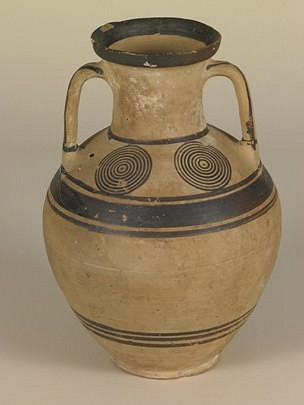
Proto-geometric Amphora
The finished pot was then ready to be put in the kiln and fired at a temperature of around 960 °C, which is relatively depression and explains the 'softness' of Greek pottery (in comparison to, for case, Chinese porcelain). Pots were fired several times (in the same kiln) in order to achieve the required finish and colouring. Offset, the pot was fired in an oxidising burn where skilful ventilation to the kiln ensured that the orangish/cherry-red of the dirt came to the fore. Then the pot was re-fired in a kiln starved of oxygen (reduction process) past adding water or damp wood inside the kiln. This ensured that the painted colours, particularly the black, darkened in colour. A third firing, over again with skilful ventilation, re-reddened the clay of the pot whilst the painted areas, now protected by a thin wash, kept their original colouring. This complicated process obviously required fantabulous timing from the potter so as not to spoil the vase with unseemly discolouring.
Potters & Painters
Painter and potter (kerameus) were commonly, although not always, separate specialists. However, lasting partnerships existed such equally betwixt the potter Ergotimos and painter Kleitas. Many individual potters and less frequently, painters, take been identified with certainty through their signatures (almost commonly as "...made this") although the bulk of Greek vases are unsigned. Still, Professor J. D. Beazley, working in the 20th century CE, identified more 500 unsigned artists distinguishable through their detail fashion. Beazley's systematic and comprehensive cataloguing of Greek pottery has also allowed for the study of its development in techniques, designs, and decoration.
A good Greek vase probably cost only a day's wages.
Painters often worked in collective workshops, more often than not nether the supervision of i 'primary' potter (which suggests form was actually more than important than decoration for the Greeks). Although artists were free from centralised political control or restrictions, they no doubt were driven by the marketplace demand for particular styles, subjects, and fashions. Many potters and artists were prolific in their output and in some cases over 200 vases may be attributed to a single artist. The majority of pottery workers would have been paid no more than any other manual labourer and a expert vase probably cost only a day's wages. Certainly though, a few artists would have been in not bad demand and their goods were sold not only locally but far and wide throughout the Mediterranean. Potters themselves sometimes relocated to other cities, particularly colonies, oft taking with them their regional mode. There was likewise some rivalry betwixt artists every bit indicated by one signed annotate on a vase, "better than Euphronias could ever accept washed".
Shapes
Although Greek pottery provides us with a wide range of shapes from cups to plates to massive amphorae, many of the forms remained relatively abiding over centuries. This is primarily considering Greek potters were producing wares for practical use - holding vino, h2o, oil, and perfumes - and one time the optimum applied shape had evolved, it was copied and maintained. Withal, despite this restriction in form, the Greek potters and painters could express their versatility in the ornament of the vase.
The most common forms of pottery were amphorae for storing wine, large kraters for mixing wine with h2o, jugs (oinochoai) for pouring wine, kylixes or stemmed cups with horizontal handles for drinking (peculiarly applied if lifting a cup from the flooring when reclining on a lounger at dinner), hydra with 3 handles for holding water, skyphoi or deep bowls, and lekythoi jars for belongings oils and perfumes. Precisely because these objects were for applied utilise, handles (when present) are more often than not sturdy diplomacy, yet the potter, by using carefully considered shapes, often managed to alloy these additions into the overall harmony of the vessel and was aided in this endeavour with subtle decorative additions by the painter.
Decorative Styles: Proto-Geometric Pottery
Greek pottery, particularly in terms of decoration, evolved over the centuries and may be categorized into four broad groups:
- Proto-geometric pottery
- Geometric pottery
- Black-figure pottery
- Ruby-red-figure pottery
These groups or styles, however, did non pass abruptly from one to the other but rather in some cases ran contemporary for decades. Also, some city-states and regions were either slow to take hold of on to new styles or simply preferred the 'one-time' style decoration long after they had gone out of production elsewhere. In add-on, some cities and regions were consistently a little eccentric in their decoration (notably Laconia-Sparta, Cyprus, Crete, and Boeotia) and preferred to follow their own artistic path rather than imitate the styles of the more dominant centres such as Athens and Corinth.
The outset distinctive Greek pottery style commencement appeared around grand BCE or perchance even earlier. Reminiscent in technique of the before Greek civilizations of Minoan Crete and the Mycenaean mainland, early on Greek pottery decoration employed simple shapes, sparingly used. Proto-Geometric pottery, notwithstanding, differs from Minoan and Mycenaean in shape. The centre of gravity of the vase is moved downwards (creating a more stable vessel) with the feet and neck more articulated.
The about pop Proto-Geometric designs were precisely painted circles (painted with multiple brushes fixed to a compass), semi-circles, and horizontal lines in black and with large areas of the vase painted solely in blackness. A new motif on the bases of vessels was the upright triangular points which would endure for centuries and go a staple feature of the later black-figure pottery pattern.
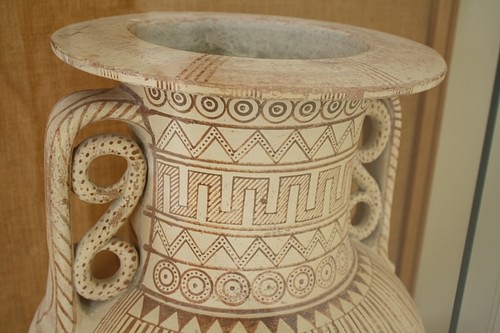
Geometric Pottery Designs
Geometric Pottery
From effectually 900 BCE the full Geometric style appeared and favoured the rectangular infinite on the main torso of the vase between the handles. Bold linear designs (perhaps influenced past contemporary basketwork and weaving styles) appeared in this space with vertical line decoration on either side. It was in this period that the Maeander design start appeared (maybe inspired by the practice of wrapping leaves around the rims of metallic bowls), destined to become forever associated with Greece and still going stiff on everything from plates to beach towels even today. The lower portion of Geometric vessels were often painted in black and separated from the rest of the vase using horizontal lines. An interesting Geometric fashion shape appeared which was the circular box with a flat chapeau, on top of which, ane to 4 horses acted every bit a handle.
The black stylized figures became more than & more precisely engraved & were given always more than detail, grace & vigour.
From the eighth century BCE, Geometric pottery decoration began to include stylized human figures, birds, and animals with most all the surface of the vase covered in bold lines and shapes painted in brown and black. Towards the end of the period in the 7th century BCE, the and so-called Orientalising style became pop in Corinth. With its eastern merchandise connections, the city appropriated the stylised plants (e.g. lotus, palm, and the tree of life), animal friezes (e.g. lions), and curved lines of Egyptian and Assyrian pottery to produce its ain unique Greek version. The rest of eastern Greece followed arrange, oftentimes preferring carmine on a white slip background. Athens also followed the new tendency and it became widespread with, for example, the Cyclades besides producing pottery in this new freer way, often on very large vases and with more spacious decoration.
At the finish of the 7th century BCE, Proto-Corinthian pottery reached new heights of technique and quality producing the finest pottery withal seen, in firing, shape, and ornament. The blackness stylized figures became more than and more precisely engraved and were given ever more detail, grace, and vigour. The celebrated black-figure pottery manner was born.

Theseus & the Minotaur
Black-effigy Pottery
Although first produced in Corinth, then with fine examples made in Laconia and southern Italy (by Euboean settlers), it would be the potters and painters of Attica who would excel higher up all others in the black-effigy style, and they would go on to boss the Greek market place for the next 150 years. Not all figures were painted blackness as sure color conventions were adopted, such as white for female flesh and imperial-red for clothes and accessories. A greater interest in fine details such as muscles and hair, which were added to the figures using a sharp musical instrument, is feature of the mode. However, it is the postures of the figures which besides mark out blackness-figure pottery as the zenith of Greek vase painting. The finest figures are given grace and poise and often illustrated in the moments earlier bodily motility or resting after exertion.
The famous vase by Exekias, with Ajax and Achilles playing a board game during the Trojan War, is an excellent example of the dignity and energy blackness-figure painting could reach. In add-on, black-figure vases often told, for the first time, a narrative. Perhaps the most historic example is the Francois Vase, a big volute krater fabricated past Ergotimos and painted past Kleitas (570-565 BCE) which is 66cm high (26 inches) and covered in 270 human being and animal figures depicting an astonishing range of scenes and characters from Greek mythology. Typical other vessels of the black-figure mode are amphorae, lekythoi, kylixes, plain cups, pyxides (small lidded boxes) and bowls.
Cherry-red-figure Pottery
The black-effigy technique was replaced by the reddish-figure technique (red figures created by painting their outline with a black slip background) around 530 BCE which would endure for the next 130 years or so. The two styles were parallel for some time and in that location are fifty-fifty 'bilingual' examples of vases with both styles but the ruby-effigy, with its advantage of the castor over the graver, could attempt to more realistically portray the human figure and eventually it became the favoured style of Greek pottery decoration. Perhaps influenced past contemporary wall painting techniques, anatomical particular, diverse facial expressions, greater detail in clothing (especially of folds, following the new style of the lighter chiton apparel which also fascinated contemporary sculptors), greater attempts at portraying perspective, the overlapping of figures, and the delineation of everyday life such as didactics and sporting scenes are all feature of this style.
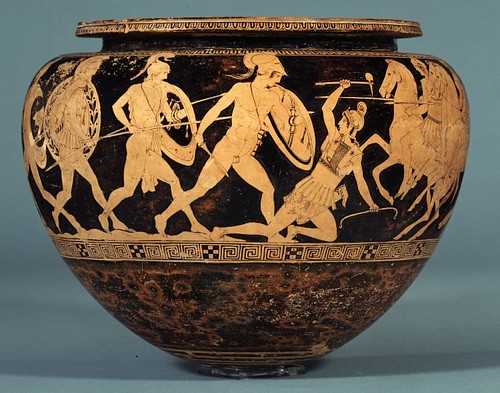
Attic Red-Figure Dinos
The shapes of red-figure vessels are generally those of the black-figure way. An exception is the kylix which becomes shallower and with a shorter foot, almost condign a third handle. In improver, the painted narrative is to be read past turning the loving cup in the hand. Other modest modifications are the hydra, which becomes a little fuller in figure and the slimmer neck-amphora. Lekythoi of this menstruation commonly had a white background as did (more than rarely) cups and boxes.
New Media
Into the fourth century BCE, perhaps in attempting to copy the innovations in perspective of contemporary fresco, the blood-red-figure style would reveal its limitations and vases would degenerate into over-packed scenes with strange floating perspectives. Significantly, pottery painting would no longer be linked intrinsically to the grade which it busy and and then ceased to be every bit an art-course in its own right. Consequently, creative attention and excellence would turn away from the confinements of pottery to other more than open media such as wall-painting.
Conclusion
In conclusion, then, nosotros may say that non but has Greek pottery given united states of america some of the virtually distinctive, influential, and beautiful shapes and designs of antiquity only it has too given us a window into the lives, practices, and beliefs of a people long gone and of whom we very often have no contemporary written record. These everyday objects, unlike those other archaeological survivors literature, sculpture, and architecture, permit us to feel a little closer to the ordinary people of the ancient world, those who could not afford fine art or precious jewellery but could indulge in possessing a finely fabricated object such as a Greek vase.
This commodity has been reviewed for accuracy, reliability and adherence to academic standards prior to publication.
Source: https://www.worldhistory.org/Greek_Pottery/
0 Response to "Ancient Greek Pottery Types History Facts Video Lesson Egypt Ancient Videos for Kids Art"
Post a Comment