Banksy Political Art in the 21th Century the House
"The art world is the biggest joke," he said. "It's a rest domicile for the over privileged, the pretentious, and the weak."
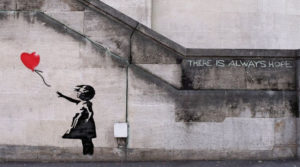
Image source: https://search.creativecommons.org/photos/51d93232-0121-4c78-94c5-b2e55b304a10 past – Dom –
Banksy is a British street artist and activist who, despite his international fame, has maintained an anonymous identity. His satirical street art and subversive epigrams combine dark humour with graffiti executed in a distinctive stenciling technique. His works of political and social commentary have been featured on streets, walls, and bridges of cities throughout the world. Banksy's piece of work grew out of the Bristol underground scene, which involved collaborations betwixt artists and musicians.
Although he was increasingly famous, Banksy remained anonymous; his rare interviews were conducted via e-mail or with responses delivered past an contradistinct voice on tape. Banksy'south name and identity remain unknown, it has been stated that the reason for this secrecy is that graffiti is a law-breaking.
As of 2014, Banksy was regarded as a British cultural icon, with young adults from abroad naming the artist among a grouping of people that they nigh associated with UK culture, which included William Shakespeare, Queen Elizabeth II, David Beckham, The Beatles, Charlie Chaplin, J. K. Rowling, Elton John and Adele.
Info source: https://en.wikipedia.org/wiki/Banksy
Info source: http://www.artnet.com/artists/banksy/
Early Career
Banksy began his graffiti art lifestyle past admiring the works of Blek Le Rat and often recycling his old ideas. He has been very active in the graffiti scene since the early on 1990s. Initially, he hung around a graffiti crew in Bristol by the name of DryBreadZ coiffure or DBZ. Soon afterward, he began to partner with Inkie, another notable graffiti street artist.
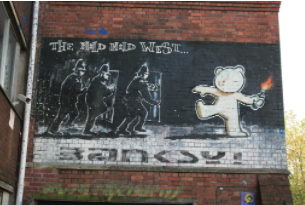
Image source: https://search.creativecommons.org/photos/a220dfd1-d351-43d9-999d-a711423c532e by KylaBorg
The most mutual form of street art Banksy uses is stencil art. These are often in the form of multi-layered stencils and/or combined with other media sources, such every bit spray-paint. He also includes anything establish in the streets like street signs and other objects to convey his message past crafting beautiful street art installations. His artwork is often satirical and combines dark humor with graffiti and as well spreads letters across art, philosophy, and politics.
Info source: http://world wide web.streetartbio.com/banksy
Major Works
He developed a distinctive iconography of highly recognizable images, such equally rats and policemen, that communicated his antiauthoritarian message. With wry wit and stealth, Banksy merged graffiti art with installation and operation. In the 2003 exhibition "Turf War," he painted on the bodies of live pigs. At his "Crude Oils" exhibition in London in 2005, which featured altered replicas of the works of Claude Monet, Vincent van Gogh, and Edward Hopper, he released 200 live rats in the gallery. In 2005 Banksy, fully bearded, installed his ain works on the walls of major museums in New York City and London, including the Metropolitan Museum of Fine art and Tate Britain.
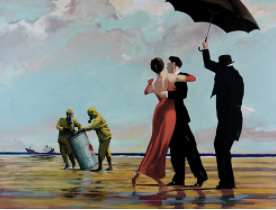
Image source: https://search.creativecommons.org/photos/98d10f51-55f3-4868-a6ca-0097a26676ec by Shht!
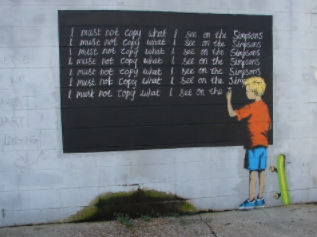
Image source: https://search.creativecommons.org/photos/dff35607-a213-4da2-a84c-8de18f146258 by Mark Gstohl
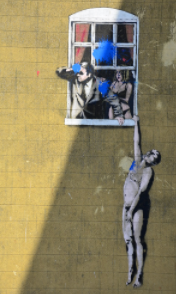
In 2005 he decided to travel to Palestine and the West Depository financial institution, where he stenciled nine images on the Bethlehem Wall.; on the viewer's side, children play on a forelorn patch of earth, while through an credible hole in the wall there is a scene of a perfect tropical beach. Banksy described himself equally a "quality vandal", challenging the authority of political and art institutions on both the right and the left. In September 2006 his one-weekend Los Angeles warehouse installation "Barely Legal" for which he busy a live elephant, attracted large crowds despite a lack of publicity. In Bristol, England, in 2006 he depicted a naked man clinging to a windowsill on the side of a public family-planning clinic; local residents voted to go along the mural.
Prototype source: https://search.creativecommons.org/photos/10f30b6b-3163-416b-9563-5244ba7459df by Ben Sutherland
Info source: https://www.britannica.com/biography/Banksy
The Bansky Effect
"There are crimes that get innocent and even glorious through their splendour, number and backlog."
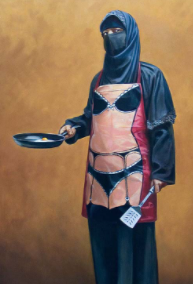
In December of 2006, journalist Max Foster coined the phrase, "the Banksy effect," to illustrate how interest in other street artists was growing on the back of Banksy's success. Considering of Banksy's ubiquity, anonymity and inventiveness, he has gained recognition and validation from the general public every bit well as cultural and governmental institutions. Farther, Banksy blurs the line between graffiti and art. What to some is vandalism is gallery worthy to others, and Banksy in particular has had many works sold in auctions for hundreds of thousands of dollars. This monetization of street art becomes particularly important for street artists, the art earth and fifty-fifty Bristol, England, where Banksy'south graffiti has become a huge cultural and economic benefit to the city.
Prototype source: http://www.banksy.co.uk/img/indoorimg/009_hdylye.jpgImage source: http://www.banksy.co.uk/in.html
Overall, Banksy has been provoking debate about social and political issues, fine art, authorship, ownership and value – likewise every bit the encouragement of what some say is graffiti.
Info source: https://rebeccakao.wordpress.com/2016/04/06/the-banksy-upshot/
Books, Movies and More…
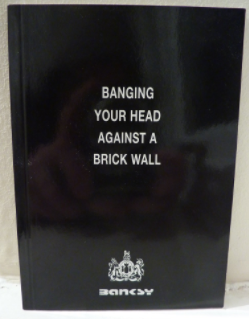
Banksy's books, which include Banging Your Caput Against a Brick Wall (2001), Existencilism (2002), and Wall and Piece (2005)—document his projects; iconic examples of his work, including a life-size image of two policemen kissing, were featured in the dour futuristic picture Children of Men (2006).
Epitome source: https://search.creativecommons.org/photos/a4c86a12-6a94-46fa-8a83-14cea13e9ad0 past erokism
Banksy directed the 2010 moving picture Exit Through the Gift Shop, a documentary that ostensibly profiled the lives and piece of work of the world's well-nigh talented graffiti artists. In January 2011, he was nominated for the University Award for Best Documentary for the film.
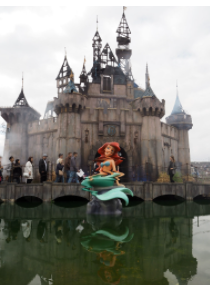
Image source: https://search.creativecommons.org/photos/5b553677-42cf-41c2-835c-ee866511e762 past Ungry Boyfriend
In September 2015 Banksy debuted Dismaland, his most-elaborate project to date, in Weston-super-Mare, England. The temporary amusement park and conceptual art show, which included work from other artists, was described by Banksy as "a family allure that acknowledges inequality and impending catastrophe." Amongst the sites and features was a false security checkpoint created by Neb Barminski where visitors' belongings were examined in a cardboard 10-ray machine, and disgruntled greeters circulated through the park wearing shirts that read "Dismal." The park also hosted late-night parties and concerts by various bands. Dismaland closed in September 2015.

Paradigm source: https://search.creativecommons.org/photos/d8407c1e-0447-42ac-b469-a3bf1edc1f75 by Ungry Swain
Info source: https://www.britannica.com/biography/Banksy
Political and Social Themes
Banksy in one case characterised graffiti as a grade of underclass "revenge", or guerilla warfare that allows an individual to snatch away power, territory and glory from a bigger and better equipped enemy. Banksy sees a social form component to this struggle, remarking "If you don't own a train visitor so you become and paint on i instead." Banksy's work has also shown a desire to mock centralised ability, hoping that their work will bear witness the public that although power does exist and works against you, that power is not terribly efficient and it tin and should exist deceived.
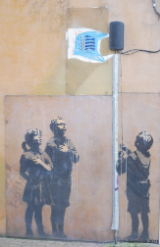
Image source: https://search.creativecommons.org/photos/5214289a-b695-42d9-bc72-d99e317989c5 by tommmmmmmmm
Banksy'southward works have dealt with various political and social themes, including anti-state of war, anti-consumerism, anti-fascism, anti-imperialism, anti-authoritarianism, anarchism, nihilism, and existentialism. Additionally, the components of the human condition that his works commonly critique are greed, poverty, hypocrisy, boredom, despair, applesauce, and alienation.
Info source: https://en.wikipedia.org/wiki/Banksy
Source: https://www.idesign.wiki/en/bansky/
0 Response to "Banksy Political Art in the 21th Century the House"
Post a Comment